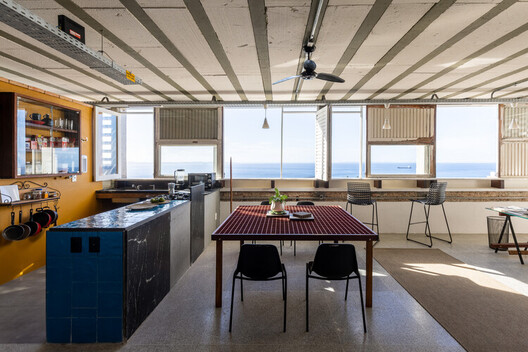
Across Europe and beyond, architects are confronting a turning point. As rising emissions targets collide with shrinking material supplies and the growing urgency of climate commitments, the built environment is being forced into a deeper reckoning with how it consumes, circulates, and discards resources. What was once considered waste is now revealing itself as a dormant architectural archive, an urban ecosystem of materials waiting to be reclaimed, revalued, or reimagined. Within this shift, architects are beginning to play a radically different role. Not only as designers of buildings, but also as orchestrators of the flows that sustain them.
This emerging mindset is reshaping the foundations of practice. Instead of depending on long, extractive supply chains, designers are beginning to build their own closed-loop networks, establishing material banks, negotiating deconstruction protocols, and participating in new forms of urban mining.
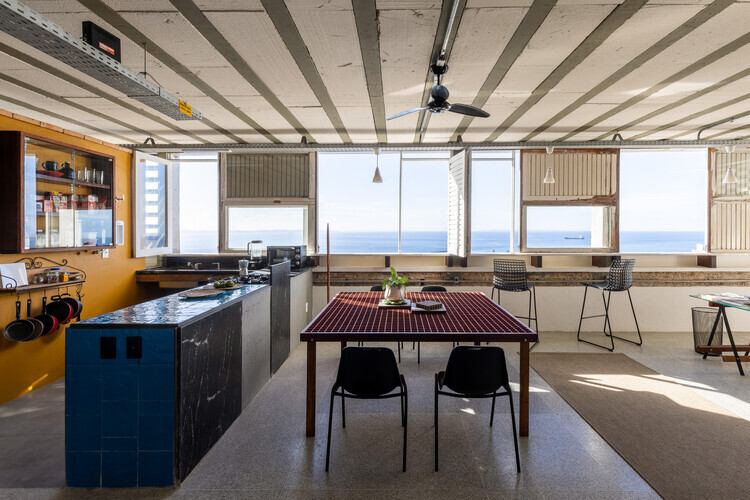
The goal is not merely to reduce waste but to cultivate new economies of continuity, where components move fluidly from one life to the next. It is a quiet but profound cultural shift, signaling a future where architecture is measured not by what it consumes, but by what it can keep in circulation.
Related Article
Material Memory: What We Lose When We Demolish BuildingsA Climate Reckoning
Construction's climate impact is now impossible to ignore. Almost 40% of global carbon emissions originate from buildings, with a growing proportion tied to embodied carbon, the emissions locked into concrete, steel, insulation, and glass before a structure is even occupied. The traditional demolition cycle, which discards these materials after only decades of use, undermines any progress made in operational efficiency. Cities are discovering the limitations of linear systems as landfill sites reach capacity and resource extraction becomes increasingly costly and unpredictable.

Against this backdrop, the economics of reuse are shifting. Salvaged materials, once treated with suspicion, are gaining new legitimacy as viable, verifiable, and often superior alternatives to the new. What was previously framed as an environmental gesture is now increasingly recognised as a strategic response to climate uncertainty. The crisis is not only ecological; it is also logistical.
Precedents Rewriting the Rules
Some of the most compelling examples of this shift come from practitioners reshaping the foundations of the industry. In Belgium, Rotor Deconstruction has pioneered a model that demonstrates how salvage can become a structured, scalable practice rather than an improvised afterthought. Through the careful extraction, cataloging, and resale of building components, from stone staircases to lighting systems. The organization blurs the line between architectural office and resource curator. Their method proves that reuse is not only possible but compatible with quality, craftsmanship, and contemporary aesthetics.

A similar ethos drives Superuse Studios in the Netherlands, where waste-stream mapping forms the basis of design. Their projects begin not with schematic forms but with inventories of what already exists, wind turbine blades, scrap steel, industrial byproducts, and forgotten stockpiles of timber. In their hands, architecture becomes the act of revealing the hidden potential of a region's waste flows.

Madaster, also based in the Netherlands, extends this philosophy into the digital domain. By creating material passports for buildings, it documents every component's origin, toxicity, recyclability, and future potential. The platform positions buildings as long-term repositories of valuable resources, assets that can be mined, redirected, and reused rather than abandoned. This redefines the building as a temporary configuration within a continuous cycle of materials.
Together, these precedents signal a shift in architectural culture: from the pursuit of novelty to the stewardship of existing value.
Rethinking the Architect's Role
As circularity becomes central to the construction economy, the role of the architect is expanding. No longer confined to aesthetic or spatial concerns, architects are increasingly asked to navigate complex questions of material logistics, lifecycle planning, and the social and economic systems tied to construction. The profession is moving towards a model where coordination, negotiation, and orchestration hold equal weight to design.

This involves new responsibilities, identifying reusable components early in a project; collaborating with contractors and municipalities to establish deconstruction protocols; integrating reclaimed elements into specifications; and designing buildings that can be dismantled just as carefully as they are assembled. It represents a shift from designing for permanence to designing for intelligent impermanence, a recognition that buildings are not static objects but temporary nodes within larger cycles of resource flow.
Cities as Material Reservoirs
Urban centres are becoming critical testing grounds for circular systems. Cities like Copenhagen, Paris, and Zurich are conducting material audits of existing building stock, identifying salvageable components before demolition and integrating mandatory reuse quotas into planning frameworks. These policies transform cities into vast material reservoirs, living archives of components that can be redirected into new construction projects.

Urban mining challenges long-held assumptions about demolition. It reframes the process not as clearing the way for renewal but as the first act of design. In London, reclaimed brick yards supply thousands of units for new housing each year, while in Paris, deconstruction hubs coordinate salvage efforts across multiple arrondissements. These initiatives reveal a new urban logic: that the materials needed for future buildings already exist, embedded in the fabric of the city.
Digital and Social Infrastructures
The infrastructure required for circularity is not only physical but digital and social. As platforms like Madaster introduce traceability into the material economy, they help to stabilize markets for reclaimed components by providing transparency and accountability. At the same time, community-led initiatives, from tool libraries to neighbourhood salvage workshops, are strengthening local reuse cultures, offering citizens a direct role in shaping resource flows.

These systems reinforce one another. Technology accelerates adoption, community networks sustain it; municipal policy embeds it into long-term planning. Together, they allow circularity to move from isolated experiments to mainstream practice.
Reuse as Cultural Practice in the Global South
While much of the circular construction discourse has been shaped in Europe, Brazil's Arquivo demonstrates how these principles can be reinterpreted within very different social, economic, and material contexts. Based in Salvador, the collective, founded by Fernanda Veiga, Pedro Alban, and Natalia Lessa has built a practice deeply influenced by Rotor's ethos but rooted in the complexities of the Global South, where informality, scarcity, and craft traditions shape the flow of materials.
Arquivo's work has already diverted more than 300 tons of building components from landfills, treating each salvage not merely as a resource but as a fragment of local memory. Their renovation of Casarão 28, an 18th-century ruin reconstructed using more than a hundred reclaimed architectural elements sourced from dozens of demolition sites, reveals how reuse can function as both environmental action and cultural preservation.

Similarly, in the Carcaré House, forty-three salvaged windows are recast into a new architectural language through a collaboration between young designers and master carpenter Seu Antônio, transforming reuse into a multigenerational craft. Their selection as winners of the ArchDaily Next Practices Awards in September 2025 underscores how circular design, when embedded in local knowledge and social networks, becomes not only a strategy for decarbonization but a catalyst for equitable, community-centered development.
A New Architectural Ethic
The shift toward reuse is not merely technical but ethical. It calls for a redefinition of architectural authorship, one that values continuity over consumption and traces responsibility beyond a building's completion. In this framework, architects become caretakers of material futures, ensuring that the choices made today enrich, rather than obstruct, the possibilities of tomorrow.
This emerging ethic does not diminish architecture's creative potential; rather, it expands it. It invites new forms of beauty, derived not from the sheen of newness but from the layered histories of materials that carry previous lives into new contexts. It imagines cities not as linear cycles of construction and destruction but as circular ecologies capable of regenerating their own resources.
As global pressures intensify, the path forward is becoming clearer. The future of architecture will not be defined by how much it can build but by how wisely it can circulate what already exists. Designing the reuse economy is not simply a response to a crisis. It is a blueprint for a more resilient, resourceful, and imaginative built environment. One that understands buildings not as endpoints, but as participants in a continuous and evolving material story.
This article is part of the ArchDaily Topics: Building Less: Rethink, Reuse, Renovate, Repurpose, proudly presented by Schindler Group.
Repurposing sits at the nexus of sustainability and innovation — two values central to the Schindler Group. By championing this topic, we aim to encourage dialogue around the benefits of reusing the existing. We believe that preserving existing structures is one of the many ingredients to a more sustainable city. This commitment aligns with our net zero by 2040 ambitions and our corporate purpose of enhancing quality of life in urban environments.
Every month we explore a topic in-depth through articles, interviews, news, and architecture projects. We invite you to learn more about our ArchDaily Topics. And, as always, at ArchDaily we welcome the contributions of our readers; if you want to submit an article or project, contact us.